
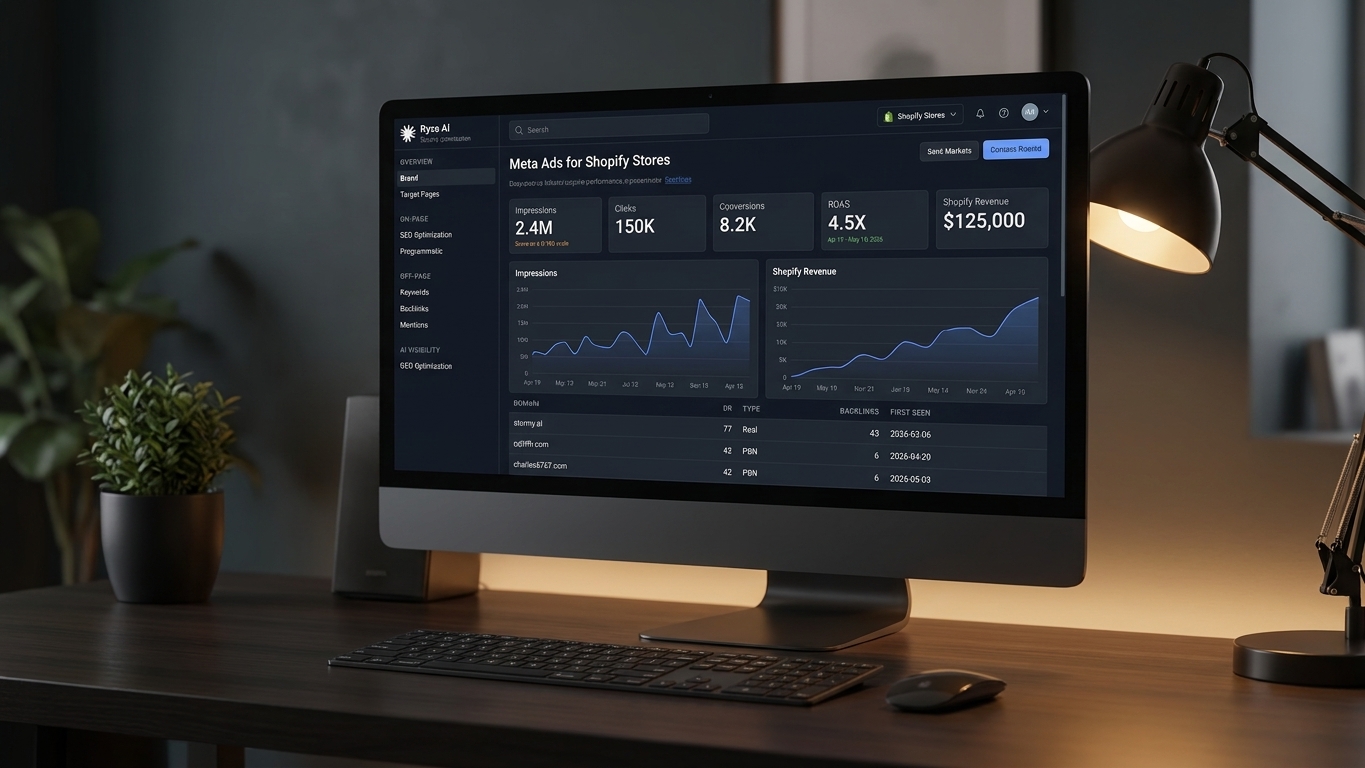
meta ads for shopify stores in 2026 means running campaigns inside a platform that's still recovering from ios privacy changes, still charging more per click than it did three years ago, and still rewarding merchants who set up tracking and creative testing correctly. this guide walks through the exact setup sequence, the optimization moves that actually move roas, and the mistakes that quietly burn budget.
tl;dr
meta ads for shopify stores work when three things are true: the pixel and conversions api are both firing, the campaign structure matches your catalog size, and creative testing runs on a weekly cadence instead of a one-time launch. shopify merchants running advantage+ shopping campaigns in 2026 typically start with a $20-$50/day budget, let the algorithm exit learning phase (usually 3-5 days, 50 optimization events per week), then scale winners by 20% every 2-3 days rather than doubling budget overnight. verdict: advantage+ shopping is the right starting structure for most shopify stores in 2026 — skip manual campaign building unless you're running above $10k/month in ad spend. tools like ryze ai exist specifically to automate the daily monitoring this setup demands.
why this matters
meta's ad auction in 2026 is more expensive and less forgiving than it was pre-2022. cpms have climbed across most ecommerce verticals, and the ios 14.5+ tracking changes never fully reversed — attribution is still probabilistic, not deterministic, for a meaningful share of ios traffic. shopify stores that treat meta ads as a set-it-and-forget-it channel bleed spend on stale creative and mistargeted audiences.
the stores that win on meta in 2026 do two things differently: they fix the data layer before touching campaign structure, and they treat creative as the primary lever, not the audience settings. audience targeting has been largely automated by advantage+; creative is the one variable you still fully control.
if you're already using ai tools for campaign management, how to use claude ai for ppc management covers a complementary workflow for google and meta account audits.
what you'll need
- a shopify store with the meta channel app installed (or manual pixel install via theme code)
- a meta business manager account with admin access to the ad account
- the meta pixel AND conversions api (capi) both configured — pixel alone is not enough in 2026
- at least 4-6 creative variants (images or video) before you launch anything
- a minimum test budget of $20-$50/day per campaign
- product catalog synced via the meta commerce manager for dynamic ads
- clean product feed data — titles, images, and availability status all accurate
the steps
1. install the pixel and conversions api together
the pixel alone misses a growing share of conversions on ios devices due to tracking restrictions that have been in place since 2022 and show no sign of loosening. conversions api sends server-side event data directly from shopify to meta, filling the gap the browser-based pixel can't cover alone.
in shopify, this is done through the meta channel app's built-in integration, which handles both pixel and capi setup in one flow. expected outcome: event match quality score of 6.0 or higher in events manager within a week of launch. common mistake: merchants install the pixel through a theme code snippet and skip capi entirely, then wonder why reported conversions run 15-30% below shopify's own order count.
2. build your catalog and enable dynamic ads
sync your full shopify catalog to meta commerce manager before launching any prospecting campaign. dynamic ads pull directly from this feed, which means retargeting and advantage+ shopping campaigns can show the exact product a visitor viewed, not a generic lookalike.
check for feed errors in commerce manager — missing gtins, disapproved images, or out-of-stock items with no availability flag will suppress those products from ad delivery. expected outcome: catalog approval status showing 95%+ of products as active with no disapprovals. common mistake: launching ads before the feed finishes syncing, which causes the first few days of delivery to underperform for reasons that look like a targeting problem but are actually a feed problem.
3. choose advantage+ shopping campaigns over manual structure
for most shopify stores, advantage+ shopping campaigns (meta's automated campaign type introduced in 2023 and now the default recommendation for ecommerce in 2026) outperform manually segmented campaigns because the algorithm has more signal to optimize against in a single ad set.
set a daily budget of $20-$50 to start, choose all available placements, and let meta's system handle audience segmentation. expected outcome: cost per purchase stabilizing within a 20% band after the initial learning window closes. common mistake: splitting budget across five small manual campaigns instead of one advantage+ campaign, which starves each one of the 50 weekly conversion events meta needs to exit learning phase.
4. load 4-6 creative variants per ad set
meta's algorithm tests creative variants against each other automatically inside an ad set, but it needs enough options to find a winner. 4-6 variants — mixing static images, short-form video, and at least one ugc-style asset — gives the system room to differentiate.
rotate in 1-2 fresh creatives every 2 weeks even for winning ad sets, since creative fatigue typically shows up as a rising cpm and falling ctr within 3-4 weeks of consistent delivery. expected outcome: at least one creative variant carrying 40%+ of ad set spend by day 10, which signals the algorithm found a clear winner. common mistake: launching with a single hero creative and no variants, which removes the algorithm's ability to test and often caps performance below what a multi-variant ad set achieves.
5. let the learning phase finish before touching anything
every time you edit budget, audience, or creative in a live ad set, meta resets the learning phase, which typically takes 3-5 days and 50 optimization events to complete. edits made mid-learning-phase reset that clock and delay stable delivery.
resist the urge to fix underperformance on day 2. expected outcome: cost per result trending down and stabilizing by day 5-7 if the setup is sound. common mistake: panic-editing budget or audience on day 1 or 2 because early numbers look bad, which restarts learning and guarantees another 3-5 days of volatile delivery.
6. scale winners by 20% every 2-3 days
once a campaign exits learning phase and shows a stable roas over 3-5 consecutive days, scale budget in 20% increments every 2-3 days rather than doubling spend overnight. large jumps in budget re-trigger a mini learning phase and often tank performance for several days.
expected outcome: roas holding within 15-20% of pre-scale levels through each increment. common mistake: doubling a winning campaign's budget after one good day, which resets learning phase and wastes the momentum the campaign had built.
troubleshooting
- conversions reported in meta don't match shopify orders. check conversions api setup first — a mismatch of 15%+ almost always traces back to incomplete capi implementation or a duplicate pixel firing.
- campaign stuck in learning phase past day 7. the ad set isn't hitting 50 weekly conversion events. either increase budget or consolidate multiple small ad sets into one.
- cpm climbing while ctr stays flat. creative fatigue. rotate in new variants — don't just refresh copy, refresh the visual.
- roas looks great in ads manager but revenue in shopify doesn't match. attribution window mismatch. meta's default 7-day click / 1-day view window often overcounts vs. shopify's actual order data — align reporting windows before comparing numbers.
- dynamic ads showing out-of-stock products. the feed isn't updating inventory status fast enough. check the sync frequency in commerce manager, which should run at least every few hours for stores with fast-moving inventory.
- advantage+ shopping campaign underperforming vs. old manual campaigns. give it the full learning window before judging — advantage+ campaigns often start slower but catch up and surpass manual structure by week 2.
tools and resources
- meta commerce manager for catalog sync and feed health checks
- meta events manager to monitor event match quality and capi status
- shopify's native meta channel app for pixel + capi installation
- an ai copilot to monitor daily performance, flag wasted spend, and generate new creative variants without manual review of every ad set
what to do next
once meta ads for shopify are live and stable, the next bottleneck is usually time — checking event match quality, rotating creative, and adjusting budgets across multiple campaigns eats hours every week. that's the exact manual work platforms like ryze ai are built to automate, from flagging wasted spend to generating new ad variants on a schedule instead of when someone remembers to do it.
faq
what's the best campaign type for meta ads on shopify in 2026? advantage+ shopping campaigns are the best starting point for most shopify stores in 2026 because they give meta's algorithm the most signal to optimize delivery, provided the catalog feed and conversions api are set up correctly first.
is meta ads or google ads better for a new shopify store? neither wins outright — meta typically performs better for visual, impulse-driven products with strong creative, while google ads captures higher-intent search traffic. most shopify stores in 2026 run both once monthly revenue passes a few thousand dollars.
how much does it cost to run meta ads for a shopify store? a reasonable starting budget is $20-$50/day per campaign, enough to generate the 50 weekly conversion events meta needs to exit learning phase within 3-5 days.
how long does the meta learning phase take? learning phase typically lasts 3-5 days and requires roughly 50 optimization events per ad set; editing budget, audience, or creative mid-phase resets that clock.
do i need conversions api if i already have the meta pixel installed? yes — the pixel alone misses a meaningful share of ios conversions due to tracking restrictions in place since 2022, and conversions api closes that gap by sending event data server-side from shopify.
how often should i refresh ad creative? rotate in 1-2 new creative variants every 2 weeks; creative fatigue typically shows up as rising cpm and falling ctr within 3-4 weeks of consistent delivery.
can i run meta ads without a big product catalog? yes, but dynamic ads and advantage+ shopping campaigns perform best with a synced catalog of at least a handful of products with clean titles, images, and accurate availability status.
should i scale a winning campaign's budget quickly? no — scale in 20% increments every 2-3 days rather than doubling spend overnight, since large jumps re-trigger a mini learning phase and can tank performance for several days.
one last thing
the single highest-leverage fix most shopify merchants skip in 2026 isn't a targeting setting — it's event match quality. a score under 6.0 in events manager means meta is optimizing against incomplete data, no matter how good your creative or budget strategy looks on paper. check that number before touching anything else.