
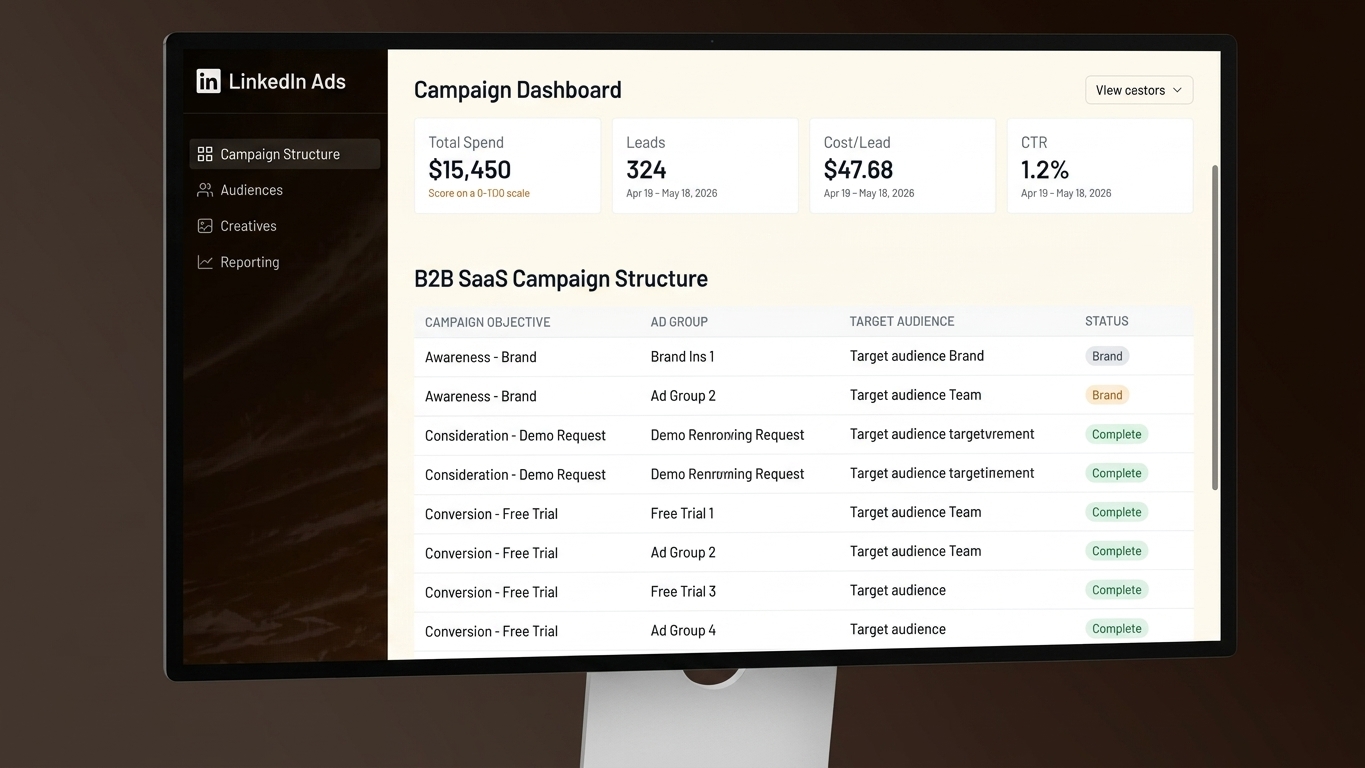
linkedin ads for b2b saas only work when the campaign structure matches how saas buyers actually move through a longer, multi-stakeholder sales cycle — this guide breaks down the account tiers, audience layers, and budget splits that separate a $40 cpl from a $400 one in 2026.
tl;dr
linkedin ads for b2b saas need a three-layer structure: cold prospecting to job-title and company-size audiences, warm retargeting to website visitors and video viewers, and a closed matched-audience layer for target accounts. budget floors sit around $10-$20/day per campaign in 2026, and conversion windows should run 90 days minimum because saas deals rarely close inside a week. the abm precision play is the strongest structure for teams selling $10k+ acv deals — buy it. broad prospecting without account exclusions is the fastest way to burn spend on the wrong titles.
why this matters
linkedin's average cpc for b2b saas sits well above meta and google — most accounts see $6 to $13 per click in 2026, and inmail sends run $0.30-$0.80 per send depending on audience size. that's expensive traffic, so a campaign structure that mixes cold, warm, and account-based layers into one ad group wastes budget on people who were never going to convert this quarter.
saas buying committees average 6-10 stakeholders per gartner's b2b buying research, and linkedin is the only paid channel built around job title, seniority, and company data instead of interest signals. that's the entire reason the platform costs more — and the entire reason a sloppy structure costs you twice. an ai ad management platform that watches spend by campaign layer daily catches the drift before it eats a month of budget.
who this is for
this structure is built for b2b saas marketers running $3k-$50k/month on linkedin who sell to defined buyer personas — vp of marketing, head of revops, director of engineering — rather than a broad consumer audience. if your acv is under $1,000 and your sales cycle closes in days, linkedin's cpc makes this channel a poor fit; that buyer belongs on google search or meta instead.
what to look for in linkedin ads for b2b saas
audience layering, not audience stacking
prospecting, retargeting, and matched-audience campaigns need separate campaign groups with separate budgets — not one audience with every targeting option checked. stacking job title + company size + skills in a single audience shrinks reach below the 50,000-member floor linkedin recommends for stable delivery, and campaigns under that threshold see erratic daily spend.
matched audience minimums
linkedin requires a minimum of 300 members to activate a matched audience for retargeting or account lists, and campaigns perform best above 1,000. if your target account list has 150 names, that list needs a broader lookalike layer around it before it's ad-ready — a 300-member list alone won't deliver consistently in 2026.
conversion window length
saas sales cycles average 84 days according to hubspot's 2026 sales benchmark report, so a 30-day linkedin conversion window undercounts every deal that takes longer to close. set the attribution window to 90 days minimum, or the platform's reporting will show a campaign as underperforming when it's actually mid-funnel.
creative format mix
document ads and single-image ads carry different engagement profiles — document ads (carousels, gated pdfs) average 2-3% engagement rate in 2026 benchmarks, roughly double single-image ads for saas categories. a structure that only runs one format leaves engagement on the table.
exclusion lists
existing customers and closed-lost accounts inside the last 90 days need exclusion at the campaign level, not the ad-group level — otherwise budget leaks toward accounts that already converted or already said no.
top picks: campaign structures ranked
the abm precision play — the safe pick for $10k+ acv
this structure runs three campaign groups: a matched-audience layer targeting a named account list (500-2,000 accounts), a job-title layer restricted to those same accounts using account lists, and a retargeting layer for website visitors from those accounts only. daily budget floor: $15/campaign. expected cpl in 2026 for this structure: $80-$150 depending on vertical. verdict: buy — this is the structure most $10k+ acv b2b saas teams should run first.
the demand gen funnel — the wildcard for pipeline volume
three stages: cold sponsored content to job-title audiences (150,000+ reach), warm retargeting to video viewers and page engagers, and a lead-gen form layer for webinar or gated content offers. this structure trades precision for volume — expect a higher cpl (often $120-$220) but 2-3x more leads per month than the abm play. verdict: consider — good for teams that need pipeline volume over precision, skip if your sales team can't handle the lead qualification load.
the inmail sequence layer — the specialist play
sponsored inmail and message ads work best as a third layer added to an existing structure, not a standalone campaign. send cadence: no more than one inmail per contact every 45 days, or deliverability and open rates drop sharply. verdict: consider — add this layer only after the first two structures are stable, never as a first campaign.
the broad prospecting sprawl — what looks efficient but isn't
a single campaign targeting "marketing managers, all industries, all company sizes" looks like it maximizes reach, but it mixes buyers who will never see a $30k acv deal with the ones who will. cpl on this structure routinely runs 2-4x higher than the abm play with none of the account-level reporting. verdict: skip — this structure looks cheap to build and gets expensive to run.
the single-audience everything campaign
cramming prospecting, retargeting, and lookalikes into one campaign group with one budget makes linkedin's algorithm optimize toward whichever audience is cheapest to serve — usually the wrong one. verdict: skip — split the budget into layers before launch, not after the first invoice.
what to avoid
- skills and interests targeting without a job-title filter — this looks precise but linkedin's skills data is self-reported and stale for a large share of profiles, inflating reach without improving match quality.
- campaign groups under 50,000 reach — delivery gets inconsistent day to day, and budget pacing tools misread the volatility as a targeting problem when it's a reach problem.
- running the same creative across all three layers — a cold audience needs a problem-statement hook, a retargeting audience needs a proof-point hook, and running one creative everywhere wastes the format's ability to match message to funnel stage.
verdict comparison table
| structure | daily budget floor | est. cpl (2026) | best for | verdict |
|---|---|---|---|---|
| abm precision play | $15 | $80-$150 | $10k+ acv | buy |
| demand gen funnel | $20 | $120-$220 | pipeline volume | consider |
| inmail sequence layer | $10 (add-on) | n/a (supplement) | warm follow-up | consider |
| broad prospecting sprawl | $15 | $200-$350 | nobody | skip |
| single-audience everything | $15 | $180-$300 | nobody | skip |
managing three separate campaign groups by hand across budgets, exclusions, and 90-day windows is where most saas marketers fall behind — an ai ad management platform that flags underspending layers and stale exclusion lists daily keeps the structure intact past week one, which is usually when manual tracking breaks down.
faq
what's the best linkedin ads structure for b2b saas in 2026? the abm precision play — a matched-audience layer, a job-title layer, and a retargeting layer, each with its own budget — wins for saas companies selling $10k+ acv deals. it isolates spend by funnel stage so reporting shows which layer is actually converting.
is linkedin better than google ads for b2b saas? linkedin wins on precision targeting by job title and company, google wins on intent-driven search volume. most b2b saas teams running $5k+/month use both, with linkedin handling account-based reach and google capturing bottom-funnel search terms.
how much does linkedin advertising cost for saas companies? cpc runs $6-$13 for most b2b saas categories in 2026, with inmail sends at $0.30-$0.80 each. daily budget floors sit around $10-$20 per campaign, and most structures need three active campaigns minimum.
how long should a linkedin conversion window be for saas? set it to 90 days. saas sales cycles average 84 days per hubspot's 2026 benchmark data, so shorter windows undercount conversions that are still moving through the pipeline.
what's the minimum audience size for linkedin retargeting? 300 members activates a matched audience, but delivery stabilizes above 1,000. lists under 300 need a lookalike layer built around them before they're ready to run.
do document ads work for b2b saas on linkedin? yes — document ads (gated pdfs, carousels) average 2-3% engagement in 2026 benchmarks, roughly double single-image ad formats for saas categories, making them a strong second layer alongside sponsored content.
should saas companies use inmail or sponsored content first? sponsored content first. inmail works best as a third layer added after prospecting and retargeting are stable — running it as a first campaign wastes send volume on audiences that haven't been warmed up yet.
how many campaigns should a b2b saas linkedin account run at once? three minimum: cold prospecting, warm retargeting, and a matched-audience layer for target accounts. fewer than three usually means budget is getting stacked into one audience instead of layered by funnel stage.
one last thing
most saas teams launch the abm precision play and stop watching it after week two — but linkedin's account list matching degrades as target accounts change roles or leave companies, and a list that was 90% accurate at launch can drop below 70% match rate by month three in 2026 without a refresh. rebuild the account list quarterly, not annually.