
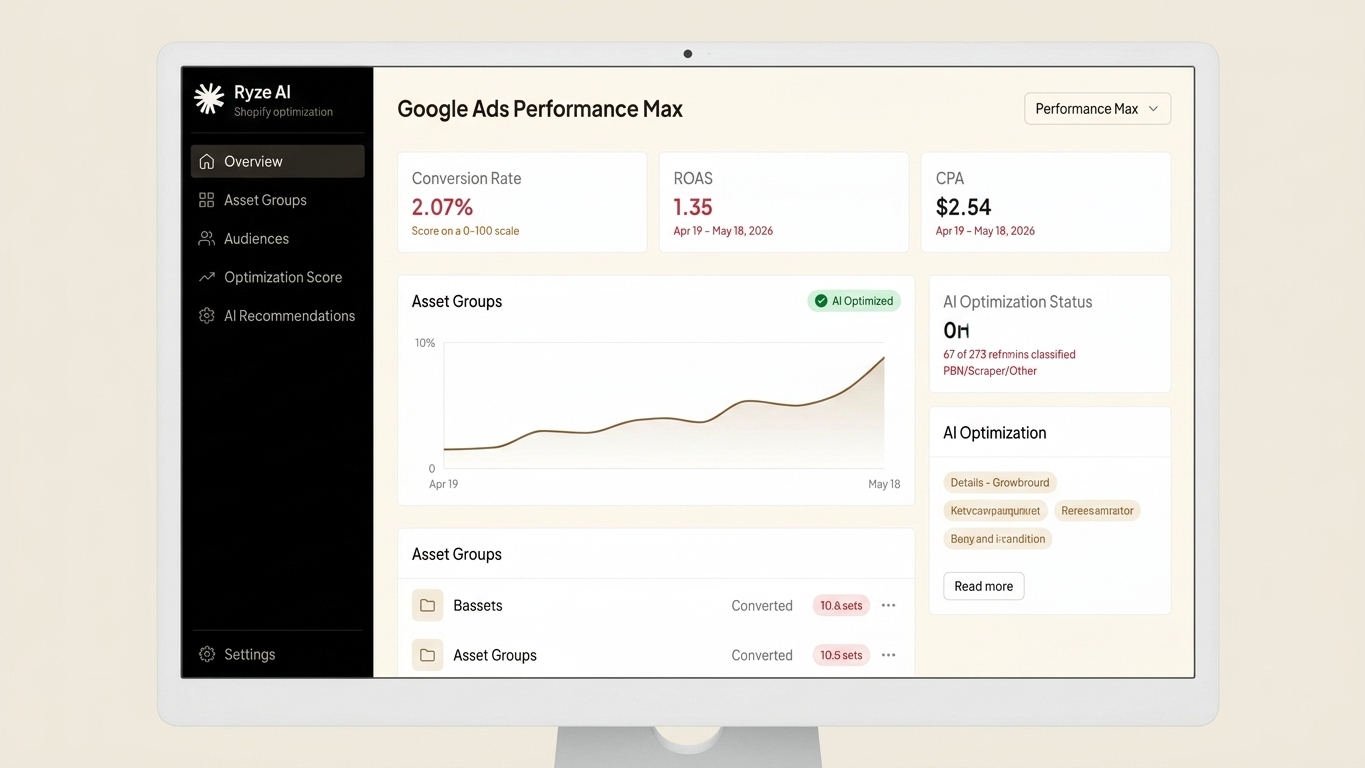
performance max optimization means fixing the black box: better asset groups, tighter audience signals, and real conversion data feeding google's algorithm instead of guesses. this guide walks through the exact steps to take a stalled pmax campaign and get it converting again in 2026.
tl;dr
performance max optimization comes down to five levers: asset group quality, audience signal accuracy, conversion data hygiene, budget pacing, and negative keyword control through brand exclusions and search theme signals. run a 14-day test window before touching bids, feed first-party data through customer match, and split high-value skus into their own asset groups instead of dumping everything into one campaign. verdict: performance max works in 2026 when you treat it as a data-feeding exercise, not a set-and-forget campaign — teams using ryze ai to automate the asset audits and signal updates see structural fixes shipped in hours instead of weeks.
why this matters
google now routes over 80% of new ad account growth through automated campaign types, and performance max sits at the center of that shift as of 2026. the problem isn't the algorithm — it's that most accounts feed it garbage: stale audience signals, thin creative, and conversion actions that don't match actual revenue.
advertisers who ignore pmax optimization watch spend drift into low-value placements while search and shopping campaigns starve for budget. the ones who fix the inputs — asset groups, signals, negatives — see the same algorithm allocate spend toward the traffic that actually converts. that's the entire game in 2026: garbage in, garbage out, still applies even to fully automated campaign types.
what you'll need
- an active performance max campaign with at least 30 days of conversion data
- google merchant center feed connected (for shopping-based pmax)
- customer match list or first-party audience data uploaded
- ga4 or server-side conversion tracking configured correctly
- 3-5 distinct asset groups planned around product or audience segments
- a tool to automate the audit — ryze ai reviews asset group performance and flags wasted spend without manual spreadsheet pulls
the steps
1. audit your conversion actions before touching anything else
performance max optimizes toward whatever conversion action you tell it matters, so a misconfigured event wrecks everything downstream. pull your conversion actions list and confirm each one reflects actual revenue, not a proxy like "add to cart" set as primary.
check attribution windows too — a 90-day window on a business with a 7-day purchase cycle skews the algorithm toward the wrong signals. common mistake: advertisers leave both "purchase" and "add to cart" set as primary conversions, splitting optimization signal in half.
2. rebuild asset groups around segments, not one giant catch-all
one asset group trying to sell 40 skus to every audience produces mediocre results across the board. split into 3-5 asset groups organized by product category, price tier, or customer intent — each with its own headlines, images, and audience signals.
expect each asset group to need at least 5 headlines, 5 descriptions, and 10 images/videos to hit "good" or "excellent" ad strength in 2026. asset groups stuck at "poor" strength for more than two weeks rarely recover without a full creative refresh.
3. feed real audience signals, not google's default guesses
audience signals are suggestions, not hard targeting, but weak signals mean google spends the first two weeks of a campaign guessing blind. upload customer match lists from your highest-ltv segment and layer in in-market audiences tied to your actual purchase categories.
refresh customer match lists monthly — stale lists from six months ago don't reflect who's buying now. why it matters: campaigns with strong first-party signals typically exit the learning phase 30-40% faster than those running on default audience expansion alone.
4. add search themes to reclaim keyword-level control
search themes, rolled out broadly in 2024 and now standard practice for performance max optimization in 2026, let you nudge the algorithm toward specific query intent without full keyword targeting. add 5-10 search themes per asset group based on your highest-converting search terms from existing search campaigns.
skip generic themes like "buy shoes online" — use the exact phrases your search query report shows converting, pulled from campaigns running alongside pmax.
5. lock down brand exclusions and placement controls
performance max can serve on placements you'd never approve manually, including some display inventory and youtube shorts that don't match your brand. use the brand exclusion list (available to all advertisers since mid-2024) to block competitor brand terms and irrelevant category terms from triggering your ads.
review the placement report inside the insights tab monthly. common mistake: advertisers set exclusions once at launch and never revisit them as new placement types roll out throughout 2026.
6. set budget pacing rules that respect the learning period
don't touch budget for the first 14 days after any major change — new asset groups, new conversion goals, new audience signals all reset part of the learning phase. after that window, move budget in 20% increments, never doubling overnight.
sudden budget spikes above 20% trigger a fresh mini-learning period that tanks efficiency for 3-5 days. expected outcome: steady 20% weekly increases on a proven asset group typically hold cpa flat while volume grows.
7. run the automated audit weekly instead of guessing
manual pmax audits eat 2-3 hours a week checking asset strength, search terms, placement reports, and signal freshness across every campaign. ryze ai automates that audit cadence and surfaces wasted spend and structural fixes without the manual pull, which matters most for agencies running pmax across a dozen client accounts in 2026.
troubleshooting
- ad strength stuck at "poor": add more image variety — most low-strength asset groups have fewer than 5 unique images. swap stock photos for lifestyle shots showing the product in use.
- cpa climbing week over week: check the search terms report first — performance max often drifts toward broad, low-intent queries after 60-90 days without fresh negative signals.
- campaign stuck in learning phase past 14 days: confirm you haven't made a structural change (new asset group, new budget, new conversion goal) that silently reset the clock.
- low impression share despite healthy budget: ad strength below "good" throttles impression volume even with money left unspent — fix creative before raising budget.
- conversions from wrong products: without segmented asset groups, high-margin products get starved by cheaper, high-volume skus competing in the same pool. split them out.
- audience signals not improving performance: signals decay — a customer match list uploaded in january 2026 and never refreshed stops reflecting current buyer behavior by mid-year.
tools and resources
- google ads insights tab — free, built-in, shows auction and placement trends
- google merchant center — required for shopping-inventory pmax campaigns
- ryze ai — automates asset group audits, flags wasted spend, and generates creative variants across performance max and other campaign types
- customer match upload tool inside google ads for first-party audience signals
- ga4 conversion tracking paired with server-side tagging for accurate signal quality
what to do next
once the campaign structure and signals are clean, the next bottleneck is usually creative volume — pmax rewards asset groups with fresh headlines and images every 30-45 days. read the guide on using claude ai for ppc management to see how ai-assisted creative and reporting workflows cut manual pmax maintenance down to minutes a week.
faq
what's the best way to start performance max optimization in 2026? start with conversion action audits before anything else — a misconfigured primary conversion undermines every other fix. from there, rebuild asset groups around segments and refresh audience signals monthly.
is performance max better than standard shopping campaigns? for most ecommerce accounts with clean feeds and conversion tracking, performance max now outperforms legacy shopping campaigns because it accesses more inventory types across search, display, and youtube simultaneously. accounts with messy conversion data or thin creative see the opposite result.
how much budget does performance max need to exit learning phase? google recommends enough budget to generate roughly 30-50 conversions in the first 30 days, though exact thresholds vary by vertical. accounts below that volume often stay in an extended learning phase with unstable performance.
can you exclude specific placements in performance max? yes — brand exclusion lists let you block placements matching competitor or irrelevant brand terms, and the placement report inside the insights tab shows where spend is actually landing.
how often should you refresh asset groups? refresh creative every 30-45 days minimum, and immediately if ad strength drops below "good" for more than two weeks straight.
does adding search themes hurt performance max's automation? no — search themes nudge intent without restricting the algorithm the way exact-match keywords do, making them one of the lowest-risk performance max optimization moves available in 2026.
how many asset groups should one performance max campaign have? most accounts perform best with 3-5 asset groups split by product category or audience segment rather than one catch-all group trying to serve every buyer.
is manual performance max optimization still realistic for agencies in 2026? manual audits across dozens of client accounts don't scale past a handful of clients — automated tools like ryze ai handle the weekly asset and signal checks that used to require dedicated analyst hours.
one last thing
most pmax accounts never touch search themes even though they've been standard practice since 2024 — that single gap is often the fastest fix available, because it hands back keyword-level intent control without breaking the automation google's algorithm depends on.